Americans Projected to Bet $3.1 Billion on the 2026 FIFA World Cup

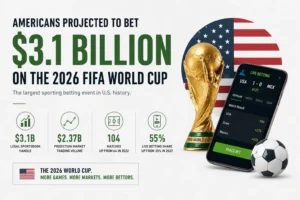
The numbers are in, and they are substantial. Over $3.1 billion will be legally wagered on the 2026 FIFA World Cup within the borders of the United States. A sum that will exceed all prior records of wagers made on soccer in America and confirm this year’s World Cup as... Show more

americans-projected-to-bet-on-2026-world-cup

Projected U.S. Betting Volume at a Glance

Category2022 Qatar (Actual)2026 ProjectionChange
Legal Sportsbook Handle$1.8B$3.1B+72%
Prediction Market Trading VolumeN/A$2.37BFirst tournament
Combined Total (Legal)~$1.8B~$5.4B++200%+
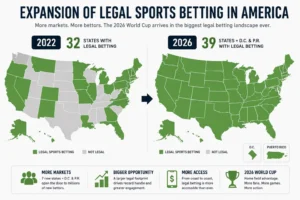
States with Legal Betting3239 + D.C. & P.R.+7 new markets
In-Play Betting Share~35% of handle~55% projected+20 percentage points
First-Time World Cup Bettors (U.S.)Baseline29% of all bettorsNew cohort

From $1.8 Billion to $3.1 Billion: How We Got Here

betting-expansion

To assess how large of a projection we’re looking at, you need to know the reference point (baseline). In 2022, Americans placed $1.8 Billion dollars in legal bets on the 2022 FIFA World Cup in Qatar. This amount itself was remarkable given that prior to 2018, American sports fans were far more likely to place wagers on American professional football, basketball, or college sports than they would be on international soccer. However, 2022 provided American bettors with massive structural disadvantages compared to the 2026 World Cup that do not exist today.

The structural factors leading to increased wagering opportunities for Americans can be identified easily and there really isn’t much argument against them:

  • Expansion of Legal Markets: When the 2022 World Cup occurred, only 32 U.S. states allowed sports wagering. Currently, 39 U.S. states allow sports wagering in addition to Washington D.C., Puerto Rico, and seven new state markets totaling dozens of million new possible bettors who will never before have participated in World Cup wagering.
  • More Games and More Betting Opportunities: A major difference between the 2022 World Cup (64 games) and the 2026 World Cup (104 games) is the increase of over 40 wagering opportunities spread throughout a six week period, greatly expanding the engagement time frame for all U.S. Sports Books.
  • A Massive Number of First-Time Betters. Paysafe Global Payment Platform reported through a survey of U.S. gamblers that 29 percent of those surveyed plan to gamble for the first time during this year’s World Cup. As such, when a person places their first-ever wager for a sports book, the opportunity to retain that person beyond the July 19th deadline for the remainder of their life exists.

The Prediction Market Wild Card: Add Another $2.37 Billion

The 3.1 Billion dollars sportsbook will be only half of the equation. In 2026 there will be another new financial system that does not currently exist today. It will be in addition to traditional betting lines for the world cup. This financial system includes new types of betting known as prediction markets. These include platforms like Kalshi and Polymarket that will have their first World Cup. Prediction markets are estimated to generate $2.37 billion in revenue. The estimate is made by comparing World Cup trade volume with Super Bowl trade volume. Every dollar generated through World Cup trades is expected to produce $1.72 worth of trades through prediction markets. Kalshi and Polymarket together produced $1.38 billion dollars in Super Bowl related trades.

The Live Betting Revolution Will Define This Tournament

The main difference between how money will flow throughout this World Cup and every other edition of the event is the tremendous growth of real time in game (live) wagering. Sportsbooks expect 55% of all handle for this tournament to originate from real time wagers. This represents an increase of 20% from the 35% in play share from Qatar 2022.

In addition to being a large increase; it also represents a fundamental change in how bettors interact with their respective sports books. In order to understand this change we need to consider the two factors that contribute to this behavior: A 6-week, 104 match tournament and/or; mobile first sports book applications designed around continuous interaction with your account while you are actively engaging with a session; and/or; an entire generation of bettors that has become accustomed through years of real time digital engagement to respond instantly to events as they unfold.

What Americans Are Actually Betting On

There are certainly some common trends or patterns that can be seen in how the money has been flowing so far regarding the betting on the World Cup. According to an American Gaming Association Survey, the U.S. National Team had the highest interest of all U.S. Soccer Bettors, followed by Brazil, Argentina, and Germany; this order was influenced more by familiarity and loyalty rather than factual probability. The odds currently available for the U.S. Men’s National Team to win the world cup are +8,000 at most bookmakers; therefore they would be considered one of the longest shots in the field of candidates to win the world cup. However, the patriotic dollars will flow as well as in volume.

The serious futures bettors’ favorites currently available to bet on include:

  • France and Spain tied as co-favorites at +500 odds at most major bookmaking establishments
  • England at +700 odds has received significant backing from the large number of U.S. citizens living abroad, who support England due to their affiliation with the English Premier League
  • Brazil and Argentina round out the top five receiving consistent bets from the growing and large U.S. Latino sports-betting population

Some of the most popular bet types that are likely to be involved in the majority of wagers made during the World Cup:

  • Outright winner futures (the most widely placed wager by handle)
  • Match three-way money line (Home/Away/DRAW) for each Group Stage Game
  • O/U Goal Totals (as these tend to attract a high volume of casual bettors)
  • Golden Boot Props (Top Scorer); a favorite among fans who follow individual players

The Shadow Market: Illegal Betting Is Bigger Than Anyone Wants to Admit

As eye-catching as the $3.1 billion legal United States sportsbooks will generate for the 2026 FIFA World Cup are, this figure only represents a small percentage of the real amount of money that Americans will wager on the event. There is an estimated large-scale underground betting market operating simultaneously alongside the regulated betting industry and the World Cup is likely to be one of the few sporting events that stimulates this type of activity more than others.

The AGA funded study indicates that 31.9 percent of U.S. gaming revenue which equates to approximately $673.6 billion annually is being generated through the illegal betting markets. These illicit operations are generating an estimated $53.9 billion in annual gross gaming revenues. As part of major international events such as the World Cup, it is anticipated that the proportion of bets placed through these channels will significantly increase as offshore books engage in intensified marketing campaigns targeting the U.S. and residents of jurisdictions where there is no authorized betting available.

The Sportsbook Arms Race: Who Stands to Win the Most

The distribution of the anticipated total handle isn’t uniform among the operators. In terms of competition for new customers, this World Cup has the potential to be the most aggressive, competitive time to date in U.S. sportsbooks’ history as they spend large amounts to attract first-time bettors that can stay beyond July 19.

Platform Projections by Operator Type

PlatformHandle ShareEdge
FanDuel / DraftKings~55-60%Brand dominance, app UX
BetMGM / Caesars~20-25%Retail presence, loyalty programs
bet365 / Fanatics~10-12%Deep soccer markets
Kalshi / Polymarket$2.37B trading volumeWider state availability
Offshore / IllegalUntrackedNo restrictions

Industry analysts believe that American gamblers will wager anywhere from $2.5 billion to $3.1 billion on the 2026 FIFA World Cup. Roughly 40% of this wagering will go through mobile sports betting platforms in states where there were no mobile sports betting platforms during the last World Cup (Qatar). The 40% figure above is the one which the largest number of operators are trying to win, it represents an entirely new market for these operators rather than simply a redistribution of current wagering handle. These are people who have never made a legal World Cup wager before; as such, the platform they make their first wager on will have an opportunity to earn a significant statistical advantage in keeping those customers throughout the remainder of the NFL season and into future seasons.

The Bigger Economic Picture

The increase in sports wagering is also part of a much bigger story about how the 2026 FIFA World Cup could create a $30 billion impact for the U.S. economy across the hospitality, travel, media, and related industries. Sports wagering is a key contributor to this overall growth by creating new financial incentives for casual fans throughout the six-week duration of the World Cup not just during the games played by the U.S. team.

As reported earlier, the New York/New Jersey region hosting the 2026 FIFA World Cup is projected to deliver an estimated $3.3 billion total economic stimulus (over 1.2 million visitors), and support over 26,000 jobs while generating an estimated $431.9 million in combined State/Local Tax Revenue generated through direct event activity. Multiply that same amount ($3.3 billion) by the 11 other host cities within the U.S., and you quickly realize that the estimates being made here are difficult to quantify.

At last count, there were three different credible estimates; however, the largest and most consistent estimate is approximately $3.1 billion. Other estimates range from $3.1 billion to as high as $3.6 billion (per Gabelli). As previously stated, there may be other estimates even higher than these. What virtually every analyst agrees on is the direction: upward sharply, with a permanent structure post-World Cup that will not collapse when the final whistle is blown at MetLife Stadium on July 19. In short, those account holders that open accounts specifically for this tournament will likely keep those accounts open after it concludes. Those jurisdictions that legalize sports wagering in advance of this World Cup, will not then prohibit it. And, while whatever final number may ultimately materialize, it is clear that the 2026 FIFA World Cup represents the first World Cup where sports wagering becomes a foundational component of the U.S. sports wagering marketplace.


subscribe-us
Sign Up for the Hottest Sweepstakes Casino Deals

Unlock FREE, Exclusive Bonuses delivered straight to you – only from SweepsPulse.

This website requires you to be 21 years or older to enter

0