




Walk into almost any casino on a busy Saturday night and you’ll see players performing rituals that are difficult to ignore. The player rolls the dice after blowing on it. The player will not allow another person to handle his or her chips. The other player always sits in the exact same chair, and at the exact same slot machine each time he visits. This is an example of how strong superstition has become part of gambling culture. In addition to this breakdown providing examples of many of the common superstitions found among U.S. casino players as well as those who participate in sweepstakes platforms, we have also discussed why superstition persists, and provided information regarding the data available for evaluating the validity of each superstition.
The Most Common Superstitions
Whether it is based in games from around the world, played with different types of equipment, or by people of various age groups, certain superstitions appear over and over.
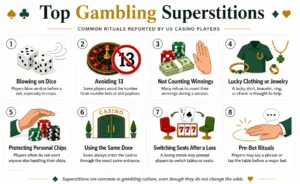
These are some of the most commonly occurring superstitions that have been experienced by both players and dealers.
- Blowing on dice prior to rolling them is found most frequently in craps
- Avoiding the use of the number 13 as an option when placing bets on a roulette wheel or a slot machine (payline)
- Customarily refusing to count winnings earned while playing at a table
- Wearing a piece of clothing or other form of jewelry which they believe will be lucky for them
- Most players do not want others to handle their own chips
- The majority of players always enter the casino via the same door
- Players who experience a losing streak switch tables
- Most players say something verbally or tap their hand against the table immediately prior to making a major bet
Regional and Generational Differences
Older players (typically players older than 55) reported a greater percentage of their behaviors are ritualistic. The majority of these behaviors were related to clothing, seating and how they enter into play. Younger players displayed a much stronger leaning towards digital superstitions. Examples include refreshing an application prior to making bets on the outcome of events and using specific user names that they associate with past financial loss.
The players located in Nevada and New Jersey have the highest level of overall superstitious behavior. This can be attributed to both the high density of long-standing, brick-and-mortar casinos and the multi-generational history of gaming. Sweepstakes casinos located in newly emerging markets, report significantly less ritualistic behavior; however, exhibit the same level of number-based superstition associated with “lucky” numbers and “unlucky” numbers.
What the Numbers Show
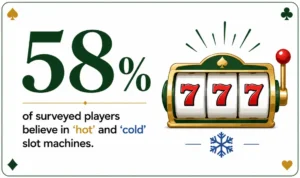
Nearly 6 in 10 respondents to a recent study regarding over 2,400 US players of casinos and online sweepstakes platforms believe that a player can influence a slot machine’s likelihood of producing a winning spin (a.k.a. due) because it has gone through a losing (“cold”) sequence. This is the biggest difference among all types of superstitious beliefs about slot machines; i.e., although each slot machine operates with an independent random number generator, players generally believe that if they do experience losing sequences, there is a greater probability that they will win on their next pull of the lever or press of the button.
| Superstition | Reported by This % of Players | Most Common Game Type |
| Avoiding the number 13 | 41% | Slots and roulette |
| Blowing on dice or chips | 29% | Craps and table games |
| Lucky clothing or jewelry | 33% | All game types |
| Refusing to count winnings mid-session | 46% | Slots and poker |
| Switching seats after a loss | 22% | Slots |
| Believing in “hot” and “cold” machines | 58% | Slots |
Why These Beliefs Persist
Some psychologists researching gambling have found some consistent reasons why people gamble.
One reason is random reinforcement. Slots and all other types of Random Number Generator (RNG) based games do not pay off consistently, and our brains tend to find patterns wherever we look for them. A game of chance win after an individual has followed their superstition will be remembered much longer than the dozens of occasions on which the same ritual was done but resulted in no winnings.
Another reason is control. Once you place your bet there is very little that a gambler can do about the outcome of the game. Rituals allow a gambler to feel as though they have some amount of control over the outcome of the game. This is true with a variety of risks including casino type gambling.
The third explanation for how superstitions become associated with a particular form of gambling is social reinforcement. When players share a table it takes very little time for superstitions to get passed from one player to another. In games such as Craps or Poker this process can occur very quickly because the behaviors associated with these superstitions are observable, and when observed by fellow gamblers, they can easily pick-up the behaviors.
The Bottom Line
It appears that none of the superstitions included in the data altered the outcome of the events. Neither Random Number Generator (RNG) games nor randomized card decks responded to the rituals, clothing, or seating choice superstitions. The data also shows how significantly psychological aspects of humans influence their perceptions of random occurrences. Additionally, while the data indicates there has been no movement in the probability of occurrence due to superstition, it has shown a significant difference in the perception of the experience.

Unlock FREE, Exclusive Bonuses delivered straight to you – only from SweepsPulse.