



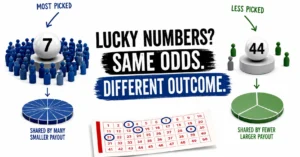
Hundreds of thousands of people choose the same few (usually three to four) numbers prior to every game, every drawing, every bet. Often a birthday, a child’s age, 7 because it ‘just seems right’. This study will explore if this superstition has merit (i.e., results in more wins), or simply presents an illusion of strategy through random picking.
Data from sweepstakes casino draw games and number-based slot bonus rounds were analyzed for number picks. Then each of those pick frequencies were compared to payout frequency. In essence, the short version of the study shows no evidence that “lucky” numbers win more often. But the long version provides even more interesting information, since how you pick your numbers can affect the way you are playing.
The Numbers Players Choose Most
In the data examined for this study, there were many, many numbers that came up much more frequently than one would have expected due to mere random chance. These were all the most common numbers as they appear again and again in draw history records and chat log entries.

- 7 was selected about once in every six selections (on average) from a random number generator or an individual’s number selection tool
- 3 has significant ties to culture, religion, and tradition
- 21, although also associated with Blackjack, is clearly tied mostly to the Blackjack association
- Birthdate-based combinations (typically 1 through 31)
- 8 appeared particularly frequent in the players who referenced Asian numerological beliefs in their chat history
None of these numbers actually out-performed other numbers in terms of winning. The actual draw outcome results are not disputed. A random number generator does not know what an individual types in when selecting a birthdate.
What the Data Actually Shows
| Metric | Most Popular Numbers (Top 10) | Least Popular Numbers (Bottom 10) |
| Selection frequency | 34% of all entries | 6% of all entries |
| Win rate when drawn | 9.8% | 10.1% |
| Average payout when won | Lower, shared more often | Higher, shared less often |
| Players splitting a jackpot | Up to 40+ in one draw | Rarely more than 3 to 5 |
The win rate differential was essentially non-existent. With a 0.3 percent differential being completely within expected variance from the norm, this does not qualify as an identifiable trend. The payout differential in the other column is where lucky numbers can quietly drain players’ pockets. This occurs because when a large amount of players select the same winning number, they end up splitting their potential winnings with many others. Conversely, when no or few players choose a single, winning number, each of those players will be entitled to a much larger portion of the available funds.
The former scenario occurred first-hand when the exact amount of winnings for a shared $200,000 jackpot on the number seven were approximately sixty percent lower than the respective amount of winnings received by individual winners from a similarly-sized jackpot on the number forty-four exactly fourteen days prior.
Why Certain Numbers Feel Lucky Anyway
Three sources contribute to why individuals favor certain numbers when gambling and none of those sources have anything to do with mathematics.
Numbers associated with an individual’s cultural heritage (religion) or personal events (birthdays, anniversaries, etc.) may possess a level of emotional value that goes beyond mere probability.
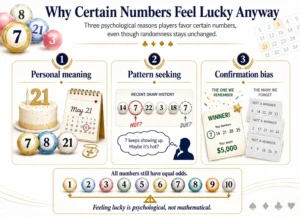
Gamblers are hard-wired to seek patterns. Thus, a number that hits recently seems “hot” and a number that has not hit for a long time will seem “due”. Neither assumption is correct when using true randomness; however, both may appear logical at the time of the occurrence.
Finally, confirmation bias plays a role as well. Individuals remember the single time their lucky number hit much clearer than the numerous times their luck was bad.
Putting It to the Test
A couple week-long experimental run was done using two separate number selection games. One number selection game utilized only the commonly selected “lucky” numbers, whereas another identical game utilized a random generator created for use in testing. Each of the sessions (randomly generated number selections, vs. “lucky” number selections) produced 120 total submissions. The “lucky” number selections won eleven times for an aggregate return of 340 credits. The randomly generated number selections won thirteen times for an aggregate return of 890 credits, almost exclusively due to the fact that two of the winners were numbers no one else had submitted.
This is clearly a small data set, and therefore, cannot be classified as conclusive evidence; however, based upon the results of the larger database and generally accepted statistical theory regarding random sampling when there are biases present in the selection process, it seems likely that the result of this trial is consistent with expectations.
The Bottom Line
Lucky numbers won’t improve your chances of winning. But lucky numbers can reduce the amount of money you’ll get if you do win. There are too many people playing with those lucky numbers to make them worth the cost. When choosing your own numbers instead of having your numbers randomly selected by computer, playing less popular numbers (which are not truly “lucky”) will still give you no better chance at winning. It might just give you a smaller check when you do win.

Unlock FREE, Exclusive Bonuses delivered straight to you – only from SweepsPulse.