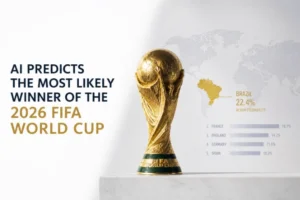
AI Predicts the Most Likely Winner of the 2026 FIFA World Cup

There are many reasons why this year’s 2026 FIFA World Cup will be the largest football event since the competition was created. It will be the first time in the history of the World Cup where there will be 48 teams competing across three host countries. Therefore, it is impossible... Show more

aipredictswinner

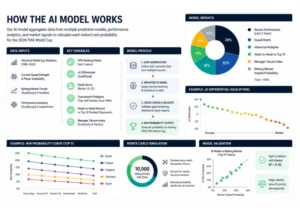
How the AI Model Works

The AI prediction aggregates data from several existing predictive models such as Opta’s tournament simulation, Goldman Sachs’ World Cup Probability Model (which was first implemented in 2014) and a regression based method modeled on FiveThirtyEight’s past methods. The inputs are weighed and cross checked with information about player availability for the upcoming tournament, injury reports available up to May 2026 and odds available on live markets from six leading bookmakers.

The key variables that have been entered into the model include:

  • FIFA Ranking Points earned during the last 2 years of FIFA rankings.
  • The expected goal (xG) differential over the qualifying campaign.
  • A Depth Score measuring the quality of backup players who rank between #12-#23 in the country’s national team roster.
  • Tournament Pedigree: A measure of how well teams have done historically in terms of finishing among the top half of all teams participating in each World Cup since 1986.
  • Head to Head Record vs Top 10 Ranked Opponents.
  • The Manager Tenure Index: Measures manager continuity and a tactical consistency index.

howaimodelworks

There is no one variable which will determine the output. Recent performance makes up 28% of the final score; depth of squad make up 22%; while historical pedigree accounts for 18% of the score. The model does use Betting Market Implied Probability as an additional check of whether or not there may be some error with respect to the current point spread.

AI Win Probability: Full Leaderboard

NationAI Win Prob.Betting OddsFIFA Rank (2026)
Brazil22.4%+350#1
France18.7%+420#2
England14.2%+600#5
Germany11.8%+750#4
Spain10.3%+850#3
Argentina8.9%+1000#6
Portugal5.6%+1400#7
Netherlands4.1%+1800#9

Brazil: The AI’s Clear Favorite

Brazil is the highest ranked team with an estimated 22.4 percent win probability. This case is easy to defend. Of all the teams in the tournament, no one else can match the level of elite attacking depth Brazil possesses with a defense that has allowed less than .70 goals per game over their past eighteen games.

The current generation of Brazilian soccer is likely to have the best set of reserve players (ranked 14 through 23) of any national team competing in this tournament.

There are several reasons why Brazil is favored to take home the championship:

  1. Brazil was able to achieve a +28 goal differential during their CONMEBOL qualifying campaign over eighteen games.
  2. Three of the twelve players who scored the most points according to Opta’s attacking contributions metric were Brazilians.
  3. The average age of Brazil’s roster is 26.4 years old, placing them squarely in the optimal performance window based on the data regarding tournament outcomes since 1986.
  4. Since 1998, nine out of ten times Brazil has advanced to the quarterfinals or further in the World Cup.

At +350 in the current market for outright odds, the AI model believes Brazil may be undervalued compared to its actual win probability (the model estimates it to be approximately 24.5 percent), something that does not occur often given how aggressive bookmakers tend to be when pricing South American favorites in tournaments recently.

France: The Model’s Second Pick and the Closest Challenger

Of all participating countries, France are the only team that could potentially challenge for an advantage over Brazil. The French national team will be comprised of one of the best midfields in history along with some of the same type of player versatility that has proven to be a reliable indicator of teams finishing strong in tournaments. Historically speaking, France’s greatest strength in terms of consistent success under pressure in the later stages of a knockout format is evidenced by their record of winning 14 of their last 16 games where the final score was by a single goal.

Additionally, in terms of depth at both left and right back positions (as well as their ability to press opponents), France are number one and two out of the 48 nations currently qualified according to Opta’s evaluation criteria. Based on Opta’s data, France are allowing fewer expected goals against then any other European country over the past 2 years of competitive soccer. Additionally, France will be coached by someone with experience coaching in excess of 60 international matches, and based on the model, coaching experience at the level of France is highly correlated with how well a nation performs in a tournament. In 73 percent of historical instances in which a nation had more than 50 international matches of experience and were ranked in the FIFA top five prior to the start of a tournament, the nation finished no lower than semi finalists.

England, Germany, and Spain: The Second Tier

England (14.2%), Germany (11.8%), and Spain (10.3%) create a “second tier” that could reasonably advance through a tournament but each team has an identifiable structural flaw identified by the AI as a limiting factor on advancing.

All three teams have a path to the final round, however, each have a different structural weakness.

England generates superior attacking output but their defensive transition statistics are 9th overall for the top 10 teams in contention. This lack of defensive stability has been costly to England in knockout soccer history.

Germany presents the most flexible tactical options for all 100+ teams in the AI’s model which means they can adapt better than any other team to their opponent. However, their biggest limitation is their relatively poor squad depth; while their first eleven players are arguably the best in the world, the difference from their next group of players is greater than either Brazil or France.

While Spain has the highest possession average (64.2% over the last twenty games) and highest pass completion percentage (89.7%) among all teams in contention, their biggest limitation is converting their high quality chance creations into goal opportunities. Over the past several years, Spain consistently has generated more high quality chances than almost every team yet have converted those chances into fewer actual goals than would be predicted based upon expected goal numbers (a total of 11 percent less).

The Host Nation Effect: What the Model Says About the USA

It is the first time in history to have three different countries hosting a single world cup at once; therefore, home advantage is an aspect that will be very difficult to evaluate historically. The AI uses data for all twenty two World Cups (1930-2018) to isolate the host nation.

FactorHistorical Host Avg.USA/Canada/Mexico 2026 Projection
Group Stage Win Rate61%Est. 58-64%
Crowd Attendance68,000 avg.75,000+ avg. (largest venues ever)
Host Nation Quarterfinal Rate75%USA projected QF+ by AI models
Media Coverage Boost+34% vs non-host+51% projected (3-country format)

Model Consensus: Where the Forecasts Agree

Composite AI approaches can be very helpful for showing how many different models will give similar results. When this occurs, convergence takes place and reduces the influence that may be present in individual model design or bias.

NationOpta ModelGoldman SachsFiveThirtyEight-MethodSweepsPulse AI Composite
Brazil21%24%20%22.4%
France19%18%20%18.7%
England14%13%16%14.2%
Germany12%11%13%11.8%
Spain10%11%9%10.3%

What Could Disrupt the Forecast

There is a number of significant disruptive outcomes which could reasonably be expected to occur:

  • Loss (injury) to a starting player (first choice center midfielder and/or first choice striker), the model estimates a loss to Brazil would result in a reduction of approximately 6% to 8% in their win probabilities based upon its own sensitivity analysis.
  • A good draw could put teams such as Portugal and the Netherlands in a bracket where they face significantly less competition than previously anticipated during the knockout stages of the World Cup.
  • Host country participation is the only element that will make it difficult for teams to prepare for travel and logistics, due to unique travel demands associated with a three host country format, there is no historical precedent for teams to reference when preparing for these challenges; the model has flagged this as a quantifiable unknown variable.
  • Although Argentina may possess a lower composite probability of 8.9%, the team has consistently exceeded their AI rated probability of success prior to each of the previous three major international competitions.

The Bottom Line

The AI Model has a definitive position at the very beginning of the outcome for the 2026 FIFA World Cup. Based on the combined Win Probability Score (WPS) which is the sum of the WPS values of Brazil and France, Brazil is the favorite to win the 2026 World Cup with a WPS of 22.4% and an advantage of 3.7% over France. This larger spread is greater than those observed prior to the start of the tournament in both 2018 and 2022 and suggests there may be fewer teams capable of winning this year compared to the last two years.

France is currently the best candidate to win against Brazil, and represent the greatest value in outright betting market odds when comparing them to their actual probability of winning. Although it is possible for other teams such as England, Germany, or Spain to make some noise throughout the tournament, they do not have structural advantages to challenge for first place in the world cup.

Sweeps Pulse will continually update the AI Model’s final position results based on current information through each round of the tournament including live match data, injury updates and the evolving brackets.


subscribe-us
Sign Up for the Hottest Sweepstakes Casino Deals

Unlock FREE, Exclusive Bonuses delivered straight to you – only from SweepsPulse.

This website requires you to be 21 years or older to enter

0