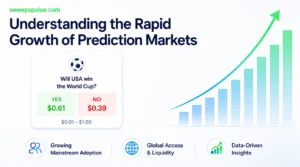
Understanding the Rapid Growth of Prediction Markets

Prediction markets were just a little-known area of the Internet where primarily economists and political enthusiasts would hang out five years ago. Now there is a multi-billion-dollar market for them with the support of institutions, government approvals as a regulated business, and large amounts of money traded on some of... Show more

image-of-understanding-the-rapod-growth-of-prediction-markets

Prediction Market Growth at a Glance

Category20222026Change
Major U.S. Platforms1 (Kalshi, limited)2+ (Kalshi, Polymarket, Crypto.com)Market expansion
Sports Event ContractsNot offeredCore product categoryNew vertical
Super Bowl Trading VolumeN/A$1.38B combinedFirst measured year
Projected World Cup VolumeN/A$2.37BFirst tournament
Kalshi Valuation~$400M~$11B (late 2025 reports)+2,600%
Polymarket U.S. AccessBlocked by CFTCReopened via QCEX acquisitionRegulatory reversal
States Where AvailableVariesAll 50 (federal framework)Nationwide reach

What a Prediction Market Actually Is

Mechanisms matter because they tell us all about the regulatory story. Predictive markets do not provide odds like a sportsbook. They list event contracts and allow traders to buy and sell them for prices between $0.01 and $1.00; these prices represent the collective probability estimate of an event based on trader sentiment. For example, if a contract for “France winning the World Cup” is trading at $0.17, then the predictive market collectively believes that there is approximately a 17% chance this will occur. Contracts settle correctly at $1.00 or incorrectly at $0.00.

There is no house in a predictive market. Traders buy from and sell to each other, and the platform generates revenue through transactional fees. This is a massive structural difference between predictive markets and sports books. It is why predictive markets are regulated by the Commodity Futures Trading Commission (CFTC) as financial exchanges rather than being regulated by individual states as gaming operators.

It may seem minor but the implications are huge.

The Three Catalysts Behind the Growth

The most recent price increase occurred very quickly; the majority of this occurred in a series of developments occurring from October 2024 through January 2026.

  • October 2024: Kalshi Court Decision. Kalshi filed an injunction against the Commodity Futures Trading Commission (CFTC) because it attempted to prevent Kalshi’s elections-based contracts from being traded. A U.S. Appellate Court allowed trading to occur. This decision essentially determined that event contracts based upon real-world occurrences could legally be issued as regulated derivative products and thus opened the doors to all subsequent activities.
  • Election of 2024: Presidential Election. During the presidential election alone, Polymarket processed over $3.3 billion in trade volume. These platforms were highly praised for providing pricing of the results of the election more accurately than traditional polls. The attention provided by the press to these platforms exposed millions of American citizens to event contracting for the first time.
  • Pivot to Sports (January 2025): After election contracts were deemed legal, Kalshi started issuing contracts on game outcomes, championships and player awards. Robin Hood then added Kalshi’s markets into their brokerage application allowing over 25 million customer accounts instant access to event contracts. In short order, sports became the major market volume driver throughout the entire space.

These three milestones build off one another. The judicial determination established the regulatory environment for event contracts. The election brought visibility to the products and demonstrated demand. And finally, sports established a consistent product with which new users become frequent traders.

The Regulatory Arbitrage Nobody Can Ignore

The unattractive reality behind the bulk of growth is this: Prediction Markets operate in every one of the fifty (50) states while Legal Sports Betting operate in forty-nine (49), plus Washington DC and Puerto Rico.

Because Event Contracts fall into Federal CFTC Jurisdiction, platforms such as Kalshi do not require State by State Licensing as does DraftKings, and FanDuel. There are approximately ninety-one (91) million adult Americans who reside within States where there is no lawful Online Sports Betting, and Prediction Markets represent the sole Regulated Channel available to these individuals.

Regulators at the State Level have taken notice. During 2025, Nevada, New Jersey, Ohio, and numerous other jurisdictions issued Cease-and-Desist Orders to Kalshi citing that despite being classified under Federal Law as a Non-Gambling Contract for Events, Event Contracts relating to Sports events were Gambling under State Law. Kalshi has challenged each of the Cease-and-Desist Orders in Court with generally favorable outcomes; however, the CFTC currently appears to be unwilling to limit the Category of Contracts. The Litigation surrounding the legality of Sports Event Contracts continues to play-out, yet the Contracts continue to trade.

Follow the Money: Institutional Capital Floods In

PlatformKey 2025 DevelopmentReported Valuation
KalshiRaised major rounds amid sports expansion~$11B by late 2025
Polymarket$2B investment from Intercontinental Exchange (NYSE parent)~$9B
PolymarketAcquired CFTC-licensed exchange QCEX for $112MRegained U.S. access
Crypto.comExpanded its own CFTC-regulated sports contractsUndisclosed

The parent company of the NYSE investing $2 billion in Polymarket clearly states that Wall Street believes event contracts will be an asset class for years to come and that they are not just a flash in the pan. Polymarkets acquisition of QCEX was also very important because it gave them a legal way to enter the US Market again after being banned from entering the US due to a CFTC settlement in 2022.

Why Bettors Are Switching

Prediction market users will require more than just a new experience to continue using prediction markets. Experienced traders know these products also have structural benefits that allow them to benefit from their betting experiences quickly. For example, price setting by competitive bidders is usually better than the price setting of a sportsbook where there is a fixed margin. In addition to selling positions prior to an event ending (a function similar to early cash out for each contract), they do not face trading restrictions/bans as experienced traders frequently do at sportsbooks. On some platforms, the tax treatment for profit from event contracts may differ than winnings from a traditional gamble; however, all traders need to verify this information with a tax advisor.

While these structural benefits exist, there are drawbacks to using a prediction market. There is typically low liquidity for small markets; most parlay and exotic wagering options are unavailable; and consumers enjoy very few protections created through state gaming laws, such as responsible gaming measures, dispute resolution processes and others available on traditional gaming exchanges.

The 2026 World Cup: A Defining Stress Test

This year’s tournament will likely be the most extensive “live experiment” conducted within this industry. A projected $2.37B in World Cup betting/World Cup trade volume can simply be explained as follows; each one dollar in Super Bowl volume will generate $1.72 in World Cup volume based on 104 games over 6 weeks and states that are currently unable to offer sports books.

If these projections hold true, the current 100% (zero) sports volume for prediction markets will have expanded to capture the equivalent of approximately 75% of all legal sports book handle for the same game/event in less than 18 months.

Where This Goes Next

The growth curve of prediction markets faces three major unanswered questions. Ultimately, courts will have to settle the jurisdiction dispute (federal vs state). Congress may also decide the category (in favor of or against) by statute. Furthermore, the companies operating these markets must demonstrate that they are able to maintain fair market conditions with their large-scale offerings; currently thin markets for remote and relatively unknown events continue to be vulnerable to market manipulations. It appears unlikely that the market will again fade into obscurity. Millions of people in America own accounts, institutional investors are committed to this new asset class and there is proven demand from users who regulatory agencies will find it difficult to eliminate. What started as an entertaining and trivial means of using prediction markets to forecast election results has evolved into a permanent component of the U.S. betting/trading marketplace.


subscribe-us
Sign Up for the Hottest Sweepstakes Casino Deals

Unlock FREE, Exclusive Bonuses delivered straight to you – only from SweepsPulse.

This website requires you to be 21 years or older to enter

0