




Most players are encouraged to continue playing by their wins; however, in reality few players are incentivized by their win. Some tend to adjust how they play as a result of their win. Unlike many other activities, winning causes the majority of gamblers to either gamble longer or at higher stakes.
The above finding has been consistently noted by researchers in the field of gaming research. Data collected from recent studies supports the findings discussed. Specifically, results from a number of surveys have shown that 63% of all gamblers increase the amount of money wagered after they win. These findings may help to explain why winning streaks usually come to an abrupt ending with a loss that completely wipes out the original winnings.
The Numbers Behind the Behavior
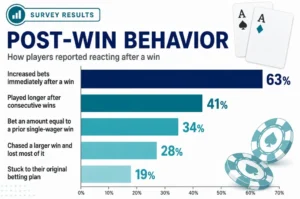
The results suggest a general pattern among different types of gamblers with regard to response to a win, although the exact percent may depend on both the type of game being played and the demographic group of gamblers involved; however, the general direction was similar, and all participants exhibited similar behavior: When someone wins money, he/she is most likely going to increase his/her odds, as opposed to decreasing them.
A few important findings resulted from this study. These included:
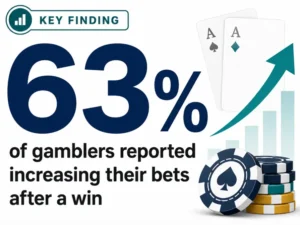
- 63% of players reported increasing their bets immediately following a win.
- 41% reported playing for a longer duration following consecutive wins than they initially intended to.
- 28% were attempting to win an additional large sum of money after experiencing success, but losing the majority of that money prior to returning to where they began.
- 34% placed at least one bet that was equal to the total amount of money won from a single wager at some point in their lifetime.
- Only 19% of the sample reported adhering to their initial betting plan regardless of whether they experienced a win or loss.
Why Winning Changes the Way People Bet
Behavioral economists call this the ‘House Money Effect’. It works simply: when you win, the amount won becomes separated from what was initially yours; you no longer think of the winnings as being “your” money, you now think of them as an extra bonus, or bonus money. This creates a psychological boundary to losing some of the winnings.
People do not view their winnings in the same way that they view their own money. As soon as a player thinks he/she has made a profit, the emotional barrier to risk all of his/her winnings (or at least most of it) comes down. The pattern has been well-documented and that is one reason why learning about yourself is almost as important as learning about the game(s).
You do not need to hit it big to trigger the House Money Effect. A relatively minor win, too minor to consider worth bragging about, can cause the psychological shift.
Which Games Show the Strongest Pattern
Some forms of gaming elicit different responses than others. Gaming formats where there are many quick rounds will generally produce larger increases in wagering after a player wins; whereas gaming formats requiring more deliberate action by the player, will create less of an increase in wagering after winning.
According to the survey:
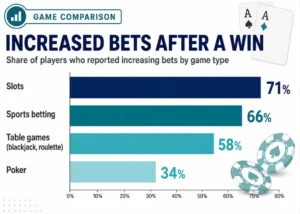
| Game Type | Increased Bets After a Win |
| Slots | 71% |
| Sports betting | 66% |
| Table games (blackjack, roulette) | 58% |
| Poker | 34% |
The difference between slot machines and poker can be clearly seen. Slot machines have very short (and rapidly occurring) round cycles, with limited opportunity for strategy or planning between each cycle. This may put players into a position to act more impulsively when they win. On the other side of the coin, poker has ongoing calculations as well as constant consideration of other players’ actions. These two factors combined may provide enough restraint to prevent excessive increases in wagering immediately after a player wins.
Age and Gender Differences
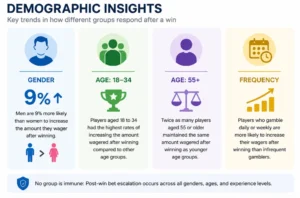
While there are some interesting demographic trends associated with gambling patterns revealed by the survey, betting escalating behavior is similar for almost everyone surveyed.
- Men have a 9% higher likelihood than women of increasing the amount they wagered on each round after winning;
- The 18-34 year old players had the highest rates of increasing the amount wagered on each round compared to other age groups;
- Twice as many players aged 55 or older maintained the same amount wagered on each round after winning as younger age groups;
- Daily/Weekly frequency of gambling was another key factor – gamblers that gamble at least once per day/week have a greater propensity to increase their wagers post-winning than infrequent gamblers.
The fact that all three categories exhibit this trend (i.e., no group is immune), suggests that both the extent of gaming experience and current life stages could be factors in how people react to winning.
How a Winning Streak Typically Unfolds
Many researchers studying gambling report that players view winning streaks as a trend, or an upward sloping line over time, instead of a singular, isolated event. A single win will rarely lead to drastic changes for a gambler. However, once a player experiences two or three consecutive wins, his/her perspective can become drastically altered. At this point, the player begins to see repeated successes as no longer being simply a result of “luck,” but as evidence that he/she has discovered some type of winning pattern.
Researchers refer to this phenomenon as the “hot hand” fallacy, the erroneous assumption that strings of successful events (wins) reflect an individual’s skill level, or good timing, as opposed to pure randomness. In the survey conducted above, 47 percent of participants reported that they believed that they would be able to identify whether they had experienced a “hot streak.” Although all of the games included within the survey (slots and nearly all casino table games), possess fixed odds that do not change based upon previous results, it appears that many players believe otherwise. Furthermore, players who reported believing in “hot hands” reported escalating their bets more frequently after a win, at 74%, compared to only 38% of players who did not subscribe to this concept.
What This Means for Responsible Gambling
Is a winning streak an indicator of whether a strategy is effective, or are the wins merely based upon luck (variance) going in a positive direction? Generally speaking, they are typically due to luck.
Winning at gambling can give you the illusion that your method is working when in reality the win may have been nothing more than variance. It’s better to determine your stop-loss prior to starting rather than determining this immediately following a win.
Why does this matter? This is critical as the minute a player determines he has “won”, his confidence increases and he will likely become less cautious; he will also want to add to those winnings.
Setting Limits Before You Play
The results of the study suggest a very straightforward conclusion: when people make spontaneous, immediate choices after winning (especially immediately after winning), those choices can often be considered more impulsive than the pre-planned choices people make before the event takes place. One of the most viable solutions to help mitigate the House Money Effect is for players to set an initial “stop win” amount at which the player will leave no matter what the game looks like at that particular moment.
There has been significant growth in sweepstakes casinos, social gaming and their related online marketing campaigns across the U.S. primarily due to allowing players to engage with casino-style games for lower-stakes. As these types of platforms use two currencies; Gold Coins and Sweep Coins, many players believe the format lends itself to encourage a more moderate approach to gaming in comparison to traditional forms of real-money betting.
Conclusion
Variance is not strategy. Odds on next bet (or any bet) are the same as when the win streak started. Confidence has simply been artificially inflated. Each session should be treated as its own independent event. Budget for that session only. Any money won by betting in that session is added to the session bankroll. Once the bankroll hits your predetermined “stop-win” amount for that session, the session ends.
Any player who develops this habit before sitting at the table does not have to rely on will power during their gameplay. This is the reason players can experience long-term success and keep the winnings they earned from gaming.

Unlock FREE, Exclusive Bonuses delivered straight to you – only from SweepsPulse.